CT Scan in Pokhara — 192-Slice High Resolution CT at KDRC
A CT scan in Pokhara at KDRC is a fast, painless X-ray test that uses a computer to create detailed cross-sectional images of the head, chest, abdomen, spine, bones and blood vessels. KDRC performs it on a 192-slice high-resolution Siemens scanner, and consultant radiologists interpret every study for your doctor.
Also called: CT, 192 slice ct, cat scan, hrct, hrct chest, city scan
- Duration
- The scan itself usually takes 10 to 20 minutes on the table,
- Reported by
- Consultant radiologists
- Location
- Amarsingh Chowk, Pokhara-10
- Book / price
- 061553538 · 9856077433
 Dr. Bishworaj Bastakoti · Consultant RadiologistMedically reviewed by Dr. Nawaraj Paudel · MD Radiology Last reviewed 12 Oct 2026Updated 12 Oct 2026
- KDRC in Pokhara uses a 192-slice high-resolution Siemens CT scanner, one of very few in Nepal.
- Most plain CT scans need no preparation; contrast scans usually need a few hours of fasting.
- A CT head gives a typical adult dose of about 1.6 mSv, roughly seven months of natural background radiation.
- CT is avoided in pregnancy unless medically necessary, and children are scanned with low-dose settings.
- Consultant radiologists Dr. Bishworaj Bastakoti and Dr. Nawaraj Paudel report CT studies at KDRC.
- CT scan prices depend on body region and contrast; call 061-553538 or 9856077433 for a quote.
On this page (13 sections)
- What is a CT scan?
- What does a 192-slice CT scanner mean?
- Why is a CT scan done?
- Types of CT scan available at KDRC
- How to prepare for a CT scan
- What happens during a CT scan?
- Is a CT scan safe? Radiation and contrast explained
- CT scan in pregnancy, for children and for older patients
- CT vs MRI vs ultrasound: which test do you need?
- When will I get my CT scan report?
- How much does a CT scan cost in Pokhara?
- Why choose KDRC for a CT scan in Pokhara?
- How to reach KDRC and book your CT scan
What is a CT scan?
A CT scan (computed tomography, also called a CAT scan) is a fast, painless imaging test that uses X-rays and a computer to build detailed cross-sectional pictures of the inside of the body. For anyone looking for a CT scan in Pokhara, Kaligandaki Diagnostic and Research Center (KDRC) at Amarsingh Chowk performs it on a 192-slice high-resolution Siemens CT scanner. Many patients in Nepal call it a "सिटी स्क्यान" or simply a "city scan".
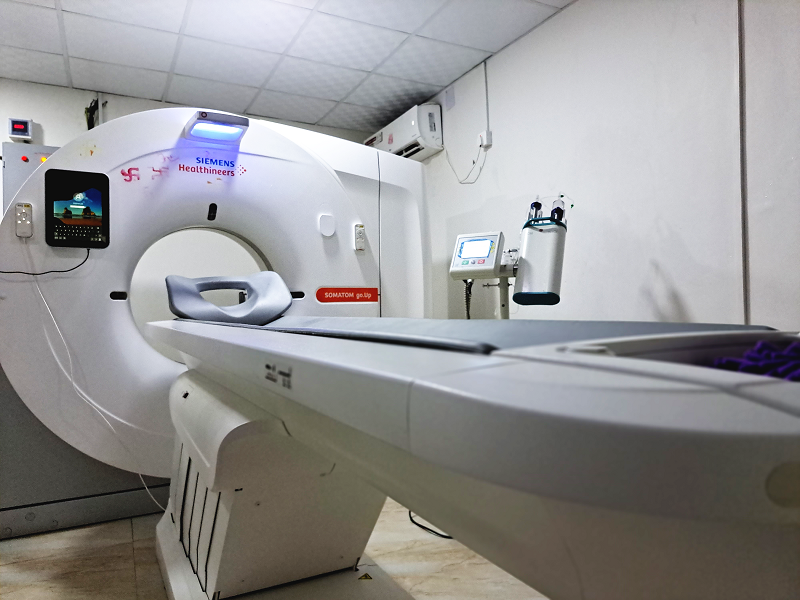
During the scan, an X-ray tube and a ring of detectors rotate around you while the table moves slowly through a wide, open ring. The computer turns these measurements into thin image "slices". It can also stack them into 3D views of bones, organs and blood vessels. CT shows organs, bones, soft tissue and blood vessels in far more detail than a plain X-ray. That detail can sometimes remove the need for exploratory surgery.
CT is used to diagnose disease and injury, to plan and guide procedures such as image-guided biopsy, and to check how well a treatment such as cancer therapy is working. Most CT scans are outpatient tests, so you go home the same day.
What does a 192-slice CT scanner mean?
A 192-slice CT scanner is a high-end machine that captures a large number of very thin image slices in each rotation, so it covers more of the body in less time. The "slice" number describes how much data the detector collects at once. Older machines in many centres capture 16 or 64 slices.
For patients, more slices bring practical benefits:
- Shorter scan time. Many examinations are complete in seconds, which helps children, elderly patients and anyone in pain.
- Shorter breath-holds. Chest and abdominal scans need you to hold your breath only briefly, which reduces blurring.
- Finer detail. Thin slices let radiologists see small structures such as lung nodules, fine fractures and small blood vessels.
- Better vessel and heart imaging. Speed matters for CT angiography, where images must be taken while contrast dye passes through the arteries.
- Dose-saving options. Modern scanners can tailor the X-ray dose to your body size and the question being asked.
KDRC's 192-slice Siemens CT is one of very few scanners of its class in the country. It means patients in Kaski and the wider Gandaki Province can have advanced CT in Pokhara rather than travelling to Kathmandu.
Why is a CT scan done?
Doctors order a CT scan when they need a quick, detailed answer about what is happening inside the head, chest, abdomen, spine, bones or blood vessels. Common reasons include:
- Head injury, suspected bleeding in the brain or stroke symptoms
- Severe or unusual headache, sinus disease and some ear problems
- Persistent cough, shortness of breath or an abnormal chest X-ray
- Pneumonia, tuberculosis, bronchiectasis and interstitial lung disease
- Abdominal pain, kidney stones, appendicitis and problems of the liver, pancreas or bowel
- Complex fractures, spine injury and planning orthopaedic surgery
- Finding, staging and following up cancer
- Injuries after road accidents or falls, where internal bleeding must be ruled out quickly
The table below shows the most common CT examinations, what each looks for and whether contrast dye is usually needed.
| CT examination | Common reasons | Contrast usually needed? |
|---|---|---|
| CT head (brain) | Head injury, stroke symptoms, bleeding, severe headache, tumour | Often plain; contrast for tumours or infection |
| CT sinuses (PNS) | Chronic sinusitis, planning sinus surgery | No |
| HRCT chest | Interstitial lung disease, bronchiectasis, long-standing breathlessness | No |
| CT chest | Lung masses, infection, chest injury, abnormal chest X-ray | Depends on the question |
| CT abdomen and pelvis | Abdominal pain, liver, pancreas, bowel and kidney problems, cancer staging | Usually yes (IV, sometimes oral) |
| CT KUB | Kidney, ureter and bladder stones | No |
| CT spine | Spine fractures, degenerative disease, surgical planning | Usually no |
| CT bones and joints with 3D | Complex fractures of the pelvis, face, wrist or ankle | No |
| CT angiography | Blocked or narrowed arteries, aneurysm, clot in the lungs | Yes (IV) |
Your doctor decides which examination you need. If your doctor writes only "CT" on the request, our radiologists will check the clinical question and choose the right protocol.
Types of CT scan available at KDRC
KDRC offers plain CT, contrast-enhanced CT, high-resolution CT (HRCT), CT angiography and CT-guided procedures on the same 192-slice scanner.
Plain (non-contrast) CT
A plain CT uses no dye. It is the usual first test for head injury, suspected stroke, kidney stones, sinus disease and fractures. It needs little or no preparation.
Contrast-enhanced CT (CECT)
A contrast CT uses an iodine-based dye injected into a vein in your arm. Sometimes you also drink an oral contrast. The dye makes blood vessels, organs and abnormal tissue such as tumours or abscesses stand out more clearly.
HRCT (high-resolution CT) of the chest
HRCT is a chest CT with very thin slices and special reconstruction to show the fine structure of the lungs. Chest physicians use it for interstitial lung disease, bronchiectasis and unexplained long-term breathlessness. Patients searching for "HRCT in Pokhara" can have it at KDRC on the same scanner.
Low-dose CT
Low-dose chest CT uses much less radiation than a standard chest CT, and in some cases the dose can be reduced by 65% or more. It is used where the clinical question allows it, for example in follow-up of known lung nodules.
CT angiography and CT-guided procedures
CT angiography maps arteries and veins and has its own page: CT angiography in Pokhara. CT can also guide a needle precisely during a biopsy or FNAC of deep lesions.
How to prepare for a CT scan
Most plain CT scans need no special preparation, while contrast CT scans usually need a few hours of fasting and some health questions answered in advance. Follow the instructions our team gives you when you book. The table below summarises typical preparation.
| Scan type | Food and drink | What to tell us | What to bring |
|---|---|---|---|
| Plain CT (head, sinus, spine, bones, KUB) | Usually eat and drink normally | Possible pregnancy | Doctor's request, previous reports and films |
| HRCT chest | Usually eat and drink normally | Possible pregnancy, breathing difficulty | Previous chest X-rays and CTs |
| Contrast CT (chest, abdomen, pelvis) | Usually nothing to eat for a few hours before; our team will tell you how long | Allergies, previous dye reaction, asthma, kidney disease, diabetes medicines, thyroid problems, pregnancy, breastfeeding | Recent kidney blood test (creatinine) if requested, list of medicines |
| CT angiography | As for contrast CT; heart scans have extra steps | As for contrast CT, plus heart rhythm problems | As for contrast CT |
A few general tips apply to every CT scan in Pokhara:
- Wear loose, comfortable clothes without metal zips, hooks or buttons. You may be asked to change into a gown.
- Leave jewellery, hair clips and coins at home or remove them before the scan.
- Keep taking your usual medicines unless your doctor or our team tells you otherwise.
- If you feel anxious, tell the staff. You can usually bring a family member with you to the centre.
- If you have had a reaction to contrast dye before, tell your doctor. Medicine can sometimes be given beforehand, or a different test chosen.
What happens during a CT scan?
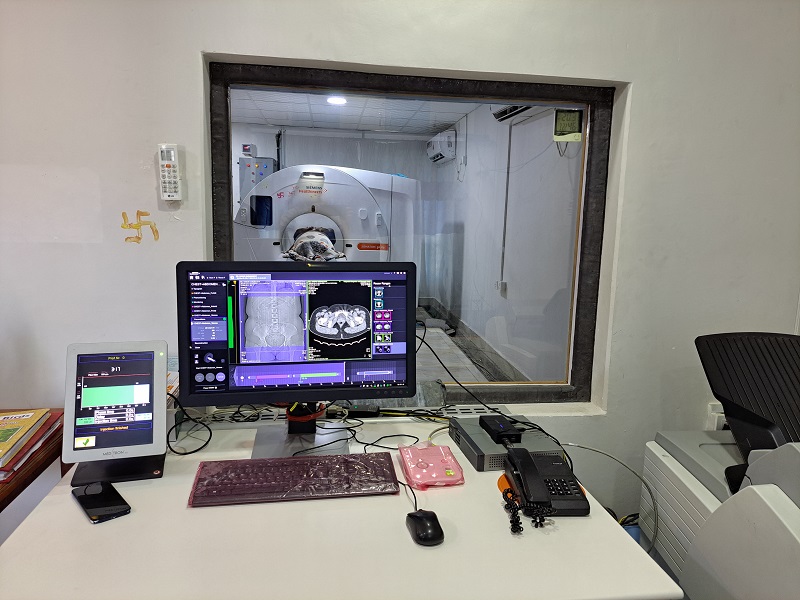
A CT scan is a short, painless test in which you lie still on a table that moves through the scanner ring while a technologist watches and talks to you from the control room. The steps below show a typical visit.
- 1Book and prepareCall 061-553538 or 9856077433 with your doctor's request. Follow any fasting advice for contrast scans.
- 2Register at receptionBring the request, previous reports and films, and a list of medicines. Tell staff about pregnancy, allergies, kidney disease or diabetes.
- 3Change and get readyRemove metal objects. For a contrast scan, a small IV cannula is placed in your arm.
- 4Lie on the scanner tableThe technologist positions you and steps into the control room, where they can see and hear you.
- 5Stay still and follow breathing instructionsThe table moves through the open ring. You may be asked to hold your breath for a few seconds.
- 6Recover and collect your reportAfter contrast you may wait up to 30 minutes. A consultant radiologist reports the scan and our team tells you when to collect it.
If contrast is injected, you may feel a warm or flushed sensation, a metallic taste, or a feeling that you need to pass urine. These feelings usually pass within a minute or two. The scanner ring is wide and open, not a tunnel, so most people who dislike small spaces cope well. The scan itself usually takes 10 to 20 minutes. After a contrast injection you may be asked to wait for up to 30 minutes so staff can make sure you feel well.
You can usually eat, drink, drive and return to normal activities straight after a CT scan, because no sedation is used for adults. Drinking extra water after a contrast scan helps the kidneys clear the dye, which leaves the body in your urine.
Is a CT scan safe? Radiation and contrast explained
A CT scan is safe for most people when it is medically justified, because the benefit of an accurate diagnosis far outweighs the small risk from radiation. CT uses ionising radiation, which may slightly increase lifetime cancer risk, mainly when many scans add up over time. Doctors therefore order CT only when it will answer a real clinical question.
Radiation dose is measured in millisieverts (mSv). The chart below compares typical adult doses with the natural background radiation everyone receives, about 3 mSv per year.
The table gives the same figures with an everyday comparison.
| Examination | Typical adult effective dose | Similar to natural background radiation over |
|---|---|---|
| Chest X-ray | 0.1 mSv | About 10 days |
| CT head | 1.6 mSv | About 7 months |
| CT chest | 6.1 mSv | About 2 years |
| CT abdomen and pelvis | 7.7 mSv | About 2.6 years |
| Coronary CT angiography | 8.7 mSv | About 3 years |
Actual doses vary with body size, the scan protocol and the reason for imaging. Thin patients and children receive much lower doses when settings are adjusted for them.
Contrast dye safety
Serious allergic reactions to iodine-based contrast are extremely rare, and CT teams are trained and equipped to treat them. Mild reactions such as itching or a rash can occur. Contrast can strain kidneys that already work poorly, so we ask about kidney disease and diabetes, and a creatinine blood test may be requested. If the dye leaks under the skin at the injection site, tell the technologist at once.
Sudden weakness of the face, arm or leg, slurred speech, a sudden severe headache, or a serious head injury needs emergency care at a hospital now, not a booked appointment. After a contrast scan, get help immediately if you develop breathing difficulty, swelling of the face or throat, or a widespread rash.
CT scan in pregnancy, for children and for older patients
CT is avoided in pregnancy unless it is medically necessary, and children have CT only when it is essential, using child-sized low-dose settings.
Pregnancy
Always tell your doctor and our staff if you are, or might be, pregnant. Ultrasound or MRI is often preferred when it can answer the same question, because neither uses X-rays. When CT is truly needed, for example after serious trauma, the radiologist adjusts the scan to keep the dose to the baby as low as possible.
Breastfeeding
Contrast manufacturers advise pausing breastfeeding for 24 to 48 hours after an injection. However, the amount of contrast that reaches the baby through breast milk is extremely low. Discuss the choice with your doctor; you can express milk beforehand if you prefer to pause.
Children
Children are more sensitive to radiation than adults and have more years ahead for any effect to appear. Paediatric scans must use paediatric settings, and repeat scans are avoided unless necessary. Fast 192-slice scanning helps young children because the scan is over before they become restless. Ultrasound or MRI may be suggested first where suitable.
Older patients and people with kidney disease
Older patients often benefit from the speed of CT. Please bring a recent kidney function test if you have kidney disease or diabetes and need a contrast scan.
CT vs MRI vs ultrasound: which test do you need?
CT is best for speed, bones, lungs, bleeding and injuries, MRI is best for soft tissue such as the brain, spine, joints and pelvis, and ultrasound is best for a radiation-free first look at organs and pregnancy. The comparison below helps you understand why your doctor picked one test.
| Feature | CT scan | MRI |
|---|---|---|
| Uses X-ray radiation | Yes | No |
| Time on the table | Seconds to minutes | Often 20–45 minutes |
| Best for | Trauma, lungs, bones, bleeding, stones | Brain, spine, joints, soft tissue |
| Metal implants | Usually fine | Must be checked first |
| Noise and space | Quiet, wide open ring | Louder; KDRC's MRI is open-type |
| Feature | CT scan | MRI | Ultrasound |
|---|---|---|---|
| How it works | X-rays and computer | Magnetic field and radio waves | High-frequency sound waves |
| Radiation | Yes (ionising) | No | No |
| Typical time on the table | Seconds to a few minutes | Often 20 to 45 minutes | 10 to 30 minutes |
| Best for | Trauma, bleeding, lungs, bones, stones, cancer staging | Brain, spine, joints, soft tissue, pelvis | Abdomen, pregnancy, thyroid, blood flow |
| Metal implants and pacemakers | Usually no problem | Must be checked first | No problem |
| Pregnancy | Avoided unless needed | Used when needed | First choice |
KDRC offers all three under one roof, including an open-type MRI and HD ultrasound, so your doctor can choose freely.
When will I get my CT scan report?
Your CT images are interpreted by a consultant radiologist, who writes a report for your doctor; our team will tell you when to collect it. Simple studies are usually reported sooner than complex cancer-staging or multi-region scans. If your doctor marked the request urgent, tell reception at registration so the study can be prioritised.
Your report explains the findings in medical terms. Your referring doctor will explain what it means for you and plan the next step. Please bring previous CT, MRI or X-ray films and reports. Comparing old and new images often makes the conclusion clearer. Hospitals and clinics outside Pokhara can also send CT studies to KDRC for expert reading through our teleradiology service.
How much does a CT scan cost in Pokhara?
The CT scan price in Pokhara depends on which part of the body is scanned and whether contrast dye is needed, so KDRC quotes each examination individually. The main factors are:
- Body region. A single region such as the head costs less than chest, abdomen and pelvis together.
- Plain or contrast. Contrast scans include the dye, an IV cannula and extra staff time.
- Special protocols. HRCT, 3D reconstructions and CT angiography need more processing.
- Procedures. CT-guided biopsy or FNAC includes the procedure itself.
For the current CT scan cost, call 061-553538 or 9856077433 (also on Viber) with your doctor's request. Our team will tell you the price and any preparation before you travel.
Why choose KDRC for a CT scan in Pokhara?
KDRC combines a 192-slice high-resolution Siemens CT, one of very few in the country, with reporting by experienced consultant radiologists, all at one centre in Pokhara.
- Advanced scanner. Fast, high-detail imaging for head, chest, abdomen, spine, bones and vessels.
- Consultant radiologists. CT studies are reported by Dr. Bishworaj Bastakoti and Dr. Nawaraj Paudel, consultant radiologists at KDRC since its inception. Both trained in radiology residency programmes in Manila, are members of the Nepal Radiologist Society and have been registered with the Nepal Medical Council as radiologists since 2016. Read more on our doctors page.
- Everything in one place. CT, MRI, ultrasound, Doppler, biopsy and FNAC are in the same building.
- Help for referring hospitals. Studies can be sent for reporting through teleradiology.
- Ambulance support. KDRC runs an ambulance service for patients who cannot travel safely on their own.
- Contrast CT of blood vessels
- CT can guide the needle
- Remote CT reporting for hospitals
- Radiation-free soft-tissue imaging
- Fine-needle sampling of lesions
- Radiation-free first-line imaging
How to reach KDRC and book your CT scan
KDRC is on Shantipath, Amarsingh Chowk, Pokhara-10, Kaski, a short ride from Lakeside, Mahendrapul and Prithvi Chowk. Ask any taxi for "Amarsingh Chowk" and look for the CT signage on the building.
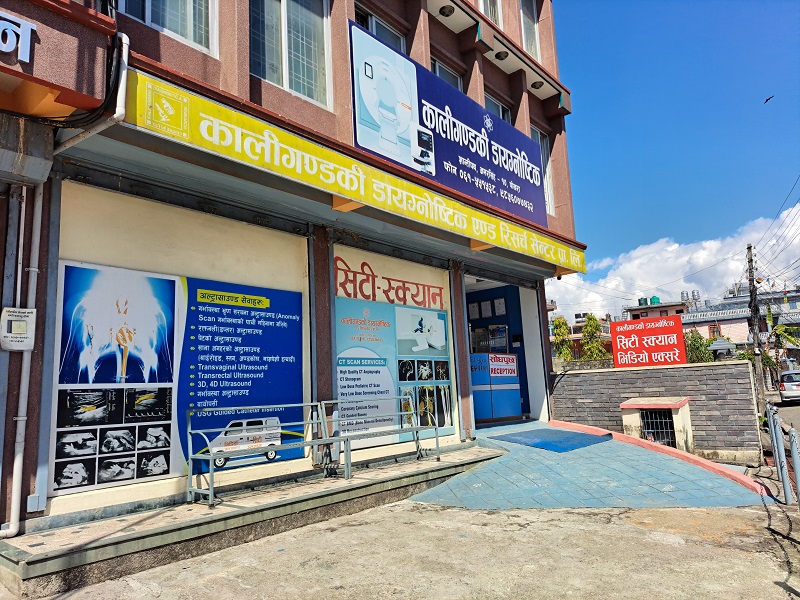
To book, call 061-553538 or 9856077433, email kaligandaki.dc@gmail.com, or use our online appointment form. Bring your doctor's request, your previous reports and films, and a list of your medicines. If you are coming from outside Pokhara, call ahead so we can confirm your slot and preparation. Services at KDRC are available any day of the week, but please call to confirm before you travel. Browse all diagnostic services to see what else can be arranged on the same visit.
How to prepare
- Bring your doctor's request, previous CT, MRI or X-ray films and reports, and a list of your medicines.
- Plain CT: usually eat, drink and take medicines as normal.
- Contrast CT: usually nothing to eat for a few hours beforehand; our team will tell you how long when you book.
- Tell us about pregnancy, breastfeeding, allergies, any previous contrast reaction, asthma, kidney disease, diabetes medicines and thyroid problems.
- Bring a recent creatinine (kidney) blood test if requested.
- Wear loose clothes without metal and leave jewellery at home.
- Call 061-553538 or 9856077433 if you are unsure about any instruction.
How long it takes
The scan itself usually takes 10 to 20 minutes on the table, and you may wait up to 30 minutes afterwards if contrast dye was used.
Price in Pokhara
CT scan cost in Pokhara depends on the body region, plain or contrast technique and any special protocol, so KDRC quotes each scan individually. Call 061-553538 or 9856077433 for the current price.
What to expect at KDRC
Arrive at KDRC on Shantipath, Amarsingh Chowk, a little before your booked time with your doctor's request, previous films and reports, and a list of your medicines. At reception you register, and staff ask about pregnancy, allergies, kidney disease, diabetes and any earlier reaction to contrast dye. If your scan needs contrast, a small cannula is placed in a vein in your arm. You remove metal objects and may change into a gown. In the scan room the technologist helps you lie on the table, usually on your back, and then steps into the control room next door, where they can see, hear and talk to you. The table glides through the wide, open ring of the 192-slice scanner. You may hear a soft whirring and be asked to hold your breath for a few seconds. If dye is injected, a warm flush or metallic taste for a minute is normal. The scanning itself is over quickly; the whole visit usually takes longer because of registration and preparation. After a contrast scan you rest for up to 30 minutes and drink plenty of water. A consultant radiologist then reviews the images and writes the report, and our team tells you when to collect it for your doctor.
Frequently asked questions
Where can I get a CT scan in Pokhara?
You can get a CT scan at Kaligandaki Diagnostic and Research Center (KDRC) on Shantipath, Amarsingh Chowk, Pokhara-10. KDRC uses a 192-slice high-resolution Siemens CT scanner, and consultant radiologists report the images. Call 061-553538 or 9856077433 to book or book online through the appointment form on our contact page.
How much does a CT scan cost in Pokhara?
The CT scan price in Pokhara depends on the body part scanned, whether contrast dye is used and whether special protocols such as HRCT or 3D reconstruction are needed. KDRC quotes each scan individually. Call 061-553538 or 9856077433 with your doctor's request, and our team will tell you the current price and any preparation needed.
What is a 192-slice CT scan?
A 192-slice CT scan is performed on a high-end scanner that captures many thin image slices in each rotation. It covers the body faster than older 16- or 64-slice machines, so breath-holds are shorter and images are sharper. KDRC in Pokhara has a 192-slice Siemens CT, one of very few in Nepal.
Is a CT scan painful?
No, a CT scan is painless. You lie still on a table while the scanner ring rotates around you. If contrast dye is injected, you may feel a small needle prick, a warm flush, a metallic taste or a feeling of needing to pass urine. These feelings usually pass within a minute or two.
How long does a CT scan take?
The scan usually takes 10 to 20 minutes on the table, and the X-ray exposure itself lasts only seconds on a 192-slice scanner. If contrast dye is used you may be asked to wait up to 30 minutes afterwards. Allow extra time for registration and preparation at the centre.
Do I need to fast before a CT scan?
Most plain CT scans of the head, sinuses, spine, bones or kidneys need no fasting. Contrast CT scans usually need a few hours without food beforehand. Our team will tell you exactly how long when you book. Keep taking your usual medicines unless your doctor or our staff tell you otherwise.
Is a CT scan safe?
Yes, a CT scan is safe for most people when it is medically justified. It uses X-ray radiation, which may slightly raise lifetime cancer risk, mainly with many repeated scans. A CT head gives about 1.6 mSv, similar to seven months of natural background radiation. Serious reactions to contrast dye are extremely rare.
Can I have a CT scan during pregnancy?
CT is generally avoided in pregnancy unless it is medically necessary. Always tell your doctor and our staff if you are or might be pregnant. Ultrasound or MRI is often preferred because they use no X-rays. When CT is essential, for example after serious injury, the radiologist keeps the dose as low as possible.
Can children have a CT scan?
Yes, children can have a CT scan when it is essential for diagnosis. Children are more sensitive to radiation, so paediatric low-dose settings are used and repeat scans are avoided. The speed of a 192-slice scanner helps because the scan finishes quickly. Ultrasound or MRI may be suggested first where suitable.
What is HRCT and is it available in Pokhara?
HRCT, or high-resolution CT, is a chest CT with very thin slices that shows the fine structure of the lungs. Doctors use it for interstitial lung disease, bronchiectasis and long-term breathlessness. HRCT is available at KDRC in Pokhara on the 192-slice CT and usually needs no contrast or fasting.
What is the difference between a CT scan and an MRI?
A CT scan uses X-rays and is very fast, making it ideal for injuries, bleeding, lungs, bones and stones. MRI uses a magnetic field and radio waves without radiation and is better for the brain, spine, joints and soft tissue. KDRC offers both, including an open-type MRI, so your doctor can choose.
When will I get my CT scan report?
A consultant radiologist at KDRC reviews your images and writes a report for your doctor. Simple scans are usually reported sooner than complex cancer-staging or multi-region studies, and our team will tell you when to collect your report. If your doctor marked the request urgent, tell reception so it can be prioritised.
Do I need a doctor's referral for a CT scan?
Yes, a CT scan needs a doctor's request, because CT uses radiation and should only be done when it answers a clinical question. Bring the request with you, along with previous films and reports. If you are unsure which scan you need, our radiologists can check the request with your doctor.
Can I drive or go back to work after a CT scan?
Yes, most adults can drive, eat and return to work straight after a CT scan, because no sedation is used. After a contrast scan, drink plenty of water to help your kidneys clear the dye. If your doctor asked you to pause any medicine, ask when to restart it.
Is KDRC open on Saturday for a CT scan?
Services at KDRC are available any day of the week, including Saturday. Times can vary, so please call 061-553538 or 9856077433 before you travel to confirm a slot and any preparation. For a suspected stroke or serious head injury, go straight to a hospital emergency department instead of waiting for a booking.
Sources
- radiologyinfo.org/en/info/safety-xray
- radiologyinfo.org/en/info/bodyct
- radiologyinfo.org/en/info/chestct
- radiologyinfo.org/en/info/headct
- nhs.uk/tests-and-treatments/ct-scan/
- fda.gov/radiation-emitting-products/medical-x-ray-imaging/computed-tomography-ct
This page is general health information reviewed by our radiologists. It is not a diagnosis — always follow your own doctor's advice. In an emergency, call our 24-hour ambulance or go to the nearest emergency department.
Written by
Dr. Bishworaj BastakotiConsultant Radiologist
Consultant Radiologist at KDRC, Pokhara. Residency at the National Kidney and Transplant Institute, Manila; previously at Western Regional Hospital. Member, Nepal Radiologist Society.
View doctor's profile →
Medically reviewed by
Dr. Nawaraj PaudelConsultant Radiologist
Consultant Radiologist at KDRC, Pokhara. Residency at East Avenue Medical Centre, Manila; formerly Assistant Professor of Radiology at Universal College of Medical Sciences. Member, Nepal Radiologist Society.
View doctor's profile →Shantipath, Amarsingh Chowk, Pokhara-10, Kaski · 061553538 / 9856077433
Related services in Pokhara
Open Type MRI
An MRI in Pokhara at KDRC is a scan that uses a strong magnet and radio waves, not X-rays, to picture the brain, spine, …
CT Angiography
CT angiography in Pokhara at KDRC is a contrast-enhanced CT scan that maps the arteries and veins of the heart, brain, n…
FNAC
An FNAC test in Pokhara at KDRC is fine needle aspiration cytology: a very thin needle draws cells from a lump, often un…
Biopsy
A biopsy test in Pokhara at KDRC is a procedure in which a small tissue sample is taken from a lump or abnormal area, us…
Teleradiology Services
Teleradiology service in Nepal from KDRC means CT, MRI and X-ray images taken at a hospital or clinic are sent securely …