
Mobile Ultrasound Service in Pokhara — Home and Bedside USG by KDRC
Mobile ultrasound service in Pokhara at KDRC brings a portable ultrasound machine and trained team to the bedside of patients who cannot easily travel, such as elderly, bedbound or recovering patients. Scans are radiation-free and reported by KDRC's consultant radiologists. Call 061-553538 or 9856077433 to check availability for your location.
Also called: home ultrasound, portable ultrasound, portable usg, bedside ultrasound, home usg, ultrasound at home
 Mobile UltrasoundKDRC · Pokhara
- Duration
- The scan itself usually takes about 10 to 45 minutes
- Reported by
- Consultant radiologists
- Location
- Amarsingh Chowk, Pokhara-10
- Book / price
- 061553538 · 9856077433
 Dr. Bishworaj Bastakoti · Consultant RadiologistMedically reviewed by Dr. Nawaraj Paudel · MD Radiology Last reviewed 12 Oct 2026Updated 12 Oct 2026
- KDRC brings portable ultrasound to the bedside for patients who cannot easily travel to a centre.
- Abdomen, kidneys, bladder, fluid, soft-tissue and many pregnancy checks suit a home visit.
- Anomaly scans, 3D/4D imaging and complex Doppler studies are best done at the centre.
- Home scans are reported by the same consultant radiologists who report centre scans.
- Call 061-553538 or 9856077433 to check availability for your location; emergencies need a hospital.
On this page (14 sections)
- What is a mobile ultrasound service?
- How does portable ultrasound work?
- Who is mobile ultrasound for?
- Which scans can be done at home?
- How to book a mobile ultrasound in Pokhara
- How to prepare the patient and the room
- Is a home ultrasound safe for elderly, bedbound and pregnant patients?
- Tips for families caring for a patient at home
- Information for referring doctors and care settings
- When to call an ambulance instead of booking a home scan
- Results and reports from a home ultrasound
- How much does a mobile ultrasound cost in Pokhara?
- Why choose KDRC for mobile ultrasound in Pokhara?
- Contact KDRC to arrange a home ultrasound
What is a mobile ultrasound service?
A mobile ultrasound service brings a portable ultrasound machine and a trained team to the patient, and KDRC offers this mobile ultrasound service in Pokhara for people who cannot easily travel to a diagnostic centre. The scan is done at the bedside, at home or in a care setting. The images are then reviewed and reported by the same consultant radiologists who report scans at our Shantipath centre. Only the place changes; the reporting standard does not.
Families search for this in many ways: "home ultrasound", "portable USG", "bedside ultrasound" or "ultrasound at home". In everyday Nepali many people call any ultrasound a "video X-ray" (भिडियो एक्स-रे), but ultrasound uses sound waves and no X-ray radiation at all. This page explains who mobile ultrasound is for, which scans suit a home visit, how to arrange one, how to prepare the room and the patient, and when a hospital visit or ambulance is the better choice.
How does portable ultrasound work?
Portable ultrasound works exactly like a standard ultrasound: a probe sends high-frequency sound waves into the body and a computer builds a live picture from the returning echoes. RadiologyInfo explains that ultrasound is non-invasive, involves no needles for most scans, uses no radiation and has no known harmful effects. The difference is size. Modern portable machines are compact enough to be carried into a home and set up beside a bed.
Hospitals worldwide use similar small devices for point-of-care ultrasound (POCUS). Cleveland Clinic describes POCUS as a portable ultrasound, sometimes the size of a tablet or phone, brought to the bedside so that care is faster and the patient does not have to be moved. It also notes the main limitation: the person scanning needs specialised training, because results depend on correct technique and interpretation. That is why KDRC sends a trained team and keeps reporting with consultant radiologists.
Portable systems trade some features for mobility. The full high-definition platform at our centre offers 3D, 4D and volume scanning and colour Doppler. A home scan is excellent for many focused questions, but some detailed studies are still best done at the centre on the HD ultrasound system.
Who is mobile ultrasound for?
Mobile ultrasound is for patients for whom the journey to a scanning centre is difficult, unsafe or exhausting. In Pokhara that often means older relatives living on upper floors, patients recovering from surgery, people with long-term illness, and families caring for someone who is bedbound. The table shows common situations and the kinds of scans doctors often request for them.
| Patient situation | Why travel is hard | Scans doctors often request |
|---|---|---|
| Elderly and frail patients | Stairs, weakness, risk of falls, long waits | Abdomen, kidneys and bladder, fluid in the abdomen or chest |
| Bedbound or paralysed patients | Cannot sit in a vehicle; need lifting | Abdomen, bladder volume, soft tissue swellings |
| Recovering after surgery or hospital stay | Pain, drains, wounds, fatigue | Abdominal or pelvic fluid collections, wound area swellings |
| Patients receiving palliative or long-term care | Every trip is tiring and uncomfortable | Fluid assessment before drainage, liver and abdomen |
| Pregnant women advised to rest | Doctor has advised limited movement | Growth, position and fluid checks when requested |
| People with disability or severe anxiety about travel | Transport and crowded waiting areas are hard | Any general scan suitable for a portable machine |
If the patient can travel safely with help, scanning at the centre is often quicker and gives access to the full equipment. Our staff will talk this through with you when you call.
Which scans can be done at home?
Most general ultrasound examinations can be done on a portable machine at home, including the abdomen, kidneys and bladder, pelvis, many pregnancy checks, soft-tissue lumps and fluid assessments. RadiologyInfo lists the liver, gallbladder, bile ducts, pancreas, spleen, kidneys and abdominal aorta among the organs an abdominal ultrasound evaluates. Some studies need the full centre system. The table is a general guide; our team confirms the right place for your scan.
| Scan | Suitable for a home visit? | Notes |
|---|---|---|
| Abdomen (liver, gallbladder, kidneys, spleen) | Usually yes | Fasting is often requested beforehand |
| Kidneys, ureters and bladder | Usually yes | Bladder volume before and after passing urine can be checked |
| Fluid in the abdomen or around the lungs | Usually yes | Helps the treating doctor plan drainage |
| Soft-tissue lumps and swellings | Usually yes | Bring any earlier reports of the same lump |
| Pregnancy growth, position and fluid | Often yes | Detailed anomaly scans are best done at the centre |
| Anomaly scan, 3D/4D scans | Centre recommended | Needs the full HD platform and more time |
| Doppler blood-flow studies | Ask our team | Complex vascular studies are best done at the centre |
| Ultrasound-guided FNAC or biopsy | Centre only | Needs a sterile procedure room |
For detailed pregnancy imaging, see our anomaly scan in Pokhara page. For blood-flow questions such as leg clots or neck arteries, see Doppler ultrasound at KDRC.
Home ultrasound vs ultrasound at the centre
A home ultrasound gives the same safe, radiation-free imaging as a scan at the centre, while the centre offers more advanced features and quicker access to further tests. Neither is "better" for everyone. The right choice depends on the patient's condition and the question the doctor is asking.
| Feature | Home (mobile) ultrasound | Centre ultrasound |
|---|---|---|
| Travel for the patient | None | Travel to Shantipath needed |
| Radiation | None | None |
| Reporting | KDRC consultant radiologists | KDRC consultant radiologists |
| 3D/4D and volume scans | Not routinely | Available |
| Complex Doppler studies | Ask our team | Available |
| Next tests (CT, MRI, FNAC) | Arranged as a separate visit | Available on site |
| Family presence | Naturally at the bedside | Usually one companion |
How to book a mobile ultrasound in Pokhara
To book a mobile ultrasound in Pokhara, call KDRC on 061-553538 or 9856077433 and give the patient's details, the doctor's request and the address. Our staff will check availability for your location and agree a visit time. Because the team travels to each patient, availability depends on the day, the distance and the other visits already planned, so please call ahead rather than waiting until the last moment. The steps below show how a booking usually works.
- 1Get a doctor's requestAsk the patient's doctor to write the scan needed and the clinical question.
- 2Call KDRCPhone 061-553538 or 9856077433 with the patient's details, the request and the full address with a landmark.
- 3Check availabilityStaff confirm whether the scan suits a home visit and check availability for your location and day.
- 4PrepareFollow fasting or full-bladder instructions and prepare a bed, light and a power socket.
- 5Bedside scanThe team sets up the portable machine beside the patient and performs the scan, with family present.
- 6ReportA consultant radiologist reviews the images. Staff tell you when and how to collect the report.
When you call, have these details ready: the patient's name and age, the scan written on the request form, the referring doctor's name, the full address with a nearby landmark, and a phone number that will be answered on the day. In Pokhara, many homes are easiest to find by a landmark such as a school, temple or chowk, so a clear landmark saves time.
How to prepare the patient and the room
Preparing for a home ultrasound means following the same patient preparation as a centre scan and arranging a comfortable space for the visiting team. The NHS notes that some scans require a full bladder, and RadiologyInfo says your doctor or the imaging team will tell you whether to avoid food or drink. Our staff give exact instructions when you book. The table summarises the usual preparation.
| Scan | Patient preparation | Room preparation |
|---|---|---|
| Abdomen | Fasting is often requested; staff confirm the hours | Bed or firm sofa, good light, a power socket nearby |
| Pelvis or bladder | A full bladder is usually needed; drink water as advised | Easy access to a toilet for afterwards |
| Pregnancy check | Usually no fasting; bring the antenatal card | Pillows to support the back and legs |
| Soft tissue or fluid | Usually no special preparation | Space on both sides of the bed if possible |
- Doctor's request form and previous scan reports ready
- Bed or firm sofa the patient can lie on, with space beside it
- Working power socket within reach
- Good light and a little privacy
- Fasting or full bladder as instructed
- Loose clothing that exposes the area to be scanned
- Medicine list and the patient's ID
- A family member available to help with positioning
If the patient has a urinary catheter, the team may ask about clamping it before a bladder scan; never do this without medical advice. Patients needing catheter care can ask about our catheter insertion service.
Is a home ultrasound safe for elderly, bedbound and pregnant patients?
A home ultrasound is safe for elderly, bedbound and pregnant patients because it uses sound waves, no radiation and no injection. RadiologyInfo notes that ultrasound has been used in pregnancy for nearly four decades with no evidence of harm, and that it should be performed when medically indicated. The scan may involve gentle pressure, and the team will help with positioning so that the patient stays comfortable.
For frail patients, a home scan avoids the strain of lifting, transport and waiting. Family members can stay in the room and help the patient turn. If the patient has pressure areas, wounds or drains, tell the team in advance so they can plan positioning.
Immobile patients carry their own risks. The NHS lists bed rest of 3 days or more and recent surgery or hospital stays among the temporary risk factors for deep vein thrombosis. If a bedbound relative develops new swelling or pain in one leg, tell their doctor; a venous Doppler is the usual test, and complex vascular studies are best done at the centre.
Tips for families caring for a patient at home
Families make a home ultrasound go smoothly by preparing information, the room and the patient before the team arrives. A few simple steps help the scan start on time and keep the patient comfortable.
- Keep papers together: place the request form, discharge summary, earlier ultrasound or CT reports and the medicine list in one folder.
- Note the question: write down why the doctor wants the scan, for example "check fluid in the abdomen" or "check kidneys", so the team and radiologist know what to focus on.
- Time medicines and meals: if fasting is needed, ask the doctor how to manage diabetes medicines and insulin during the fast. Do not stop any medicine on your own.
- Plan pain relief: if the patient finds turning painful, ask their doctor whether usual pain relief can be given beforehand.
- Clear a path: make sure the team can reach the room easily with the equipment, especially in houses with narrow stairs.
- Keep the phone on: the team may call for directions near the landmark you gave.
After the visit, keep a copy of every report. Patients who are scanned again later benefit when the radiologist can compare the new images with earlier findings.
Information for referring doctors and care settings
Referring doctors can request a mobile ultrasound by writing the examination and a short clinical question on a standard request, exactly as for a centre scan. A focused question, such as "ascites, volume and suitability for tap" or "post-void residual", helps the visiting team and the reporting radiologist answer precisely. Please include relevant history, recent blood results that affect interpretation, and earlier imaging if available.
Portable imaging has known strengths and limits. It is well suited to repeat assessments of fluid, bladder volume and many abdominal and pregnancy questions. Detailed obstetric anatomy, 3D/4D imaging, complex vascular studies and ultrasound-guided procedures such as FNAC or biopsy are best scheduled at the centre. Care facilities and clinics can call 061-553538 or 9856077433 to discuss how home or bedside scanning could support their patients, and to check availability for their location.
When to call an ambulance instead of booking a home scan
A home ultrasound is a planned diagnostic visit, not an emergency service. Some symptoms need a hospital emergency department straight away.
Seek emergency care straight away for chest pain, sudden breathlessness, severe or sudden abdominal pain, heavy bleeding, bleeding or severe pain in pregnancy, reduced baby movements, fainting, confusion, or sudden weakness of the face, arm or leg. Call an ambulance, such as the 24/7 KDRC ambulance, rather than waiting for a planned visit.
For transfers to the centre or to hospital, KDRC runs a 24/7 ambulance service. Sometimes the best plan is to bring the patient by ambulance for a full scan at the centre, where CT and other tests are available if needed.
Results and reports from a home ultrasound
Home ultrasound images are reviewed and reported by KDRC's consultant radiologists, Dr. Bishworaj Bastakoti and Dr. Nawaraj Paudel, exactly as in-centre scans are. Both have been NMC-registered radiologists since 2016, are members of the Nepal Radiologist Society, and have worked at KDRC since the centre began. Dr. Paudel trained at East Avenue Medical Centre in Manila and has taught radiology as a former assistant professor at Universal College of Medical Sciences.

Timing depends on the scan and the findings. Our team will tell you when the report will be ready and how to collect it. The report should go to the doctor who requested the scan, together with the clinical question. If a finding needs urgent action, the team will advise you to contact the doctor promptly. Hospitals and clinics that need remote image review can learn about our teleradiology service.
How much does a mobile ultrasound cost in Pokhara?
The cost of a mobile ultrasound in Pokhara depends on the type of scan and the distance to the patient's location, so KDRC quotes each visit individually. A home visit includes the team's travel and set-up time in addition to the scan itself, so it usually differs from the price of the same scan at the centre. More than one scan in the same visit also affects the total. For the current price and availability for your location, call 061-553538 or 9856077433 (also on Viber).
Why choose KDRC for mobile ultrasound in Pokhara?
KDRC links home scanning with a full diagnostic centre, so a home scan can be followed by the right next test without starting over somewhere else.
- Consultant reporting: home scans are reported by the same consultant radiologists who report scans at the centre.
- Back-up of a full centre: HD ultrasound with 3D/4D and colour Doppler, a 192-slice Siemens CT and open-type MRI on Shantipath.
- Transport when needed: a 24/7 ambulance for patients who need to come in.
- Clear guidance: staff tell you whether a home visit or a centre scan suits the question, and how to prepare.
- Full 3D/4D platform
- Blood-flow studies
- Remote reporting for hospitals
- Detailed pregnancy scan at the centre
- Transfers to the centre or hospital
- Care for bedbound patients
Contact KDRC to arrange a home ultrasound
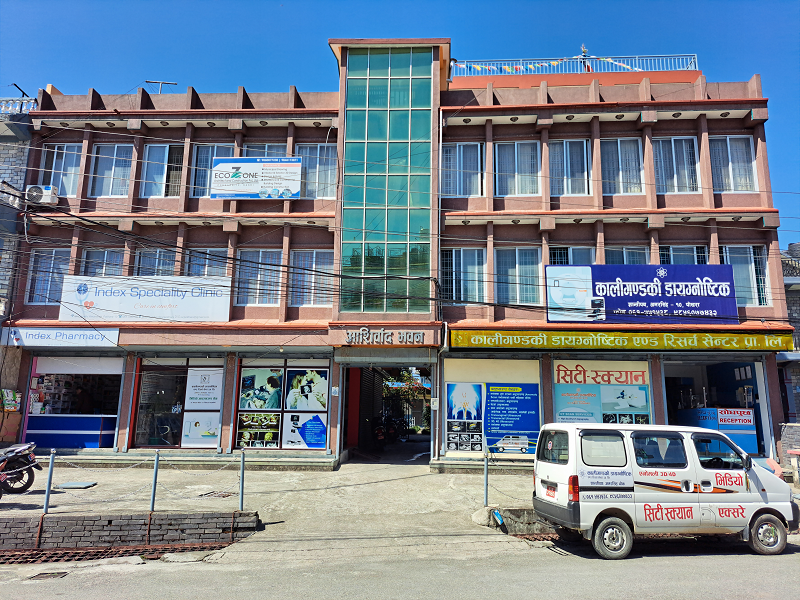
Kaligandaki Diagnostic and Research Center is on Shantipath, Amarsingh Chowk, Pokhara-10, Kaski. Call 061-553538 or 9856077433, email kaligandaki.dc@gmail.com, or send a request through the appointment form and our team will call you back to check availability for your location. If your doctor has asked for several tests, see all KDRC services to plan which can be done at home and which at the centre.
How to prepare
- Keep the doctor's request form, ID, medicine list and earlier reports ready.
- Follow fasting instructions for an abdominal scan, or drink water for a full bladder if asked.
- Prepare a bed or firm sofa with space beside it, good light and a nearby power socket.
- Dress the patient in loose clothing that exposes the area to be scanned.
- Arrange a family member to help with positioning.
- Tell staff about wounds, drains, catheters or pressure areas when you book.
How long it takes
The scan itself usually takes about 10 to 45 minutes, plus time for the team to set up and pack away the portable machine.
Price in Pokhara
Mobile ultrasound cost depends on the scan type and the distance to the patient's home, so each visit is quoted individually. Call 061-553538 or 9856077433 for the current price and availability for your location.
What to expect at KDRC
After you call with the patient's details, the doctor's request and the address, our staff confirm that the scan suits a home visit, explain any fasting or full-bladder preparation, and check availability for your location before agreeing a time. On the day, the visiting team arrives with the portable ultrasound machine, introduces themselves and checks the request form. They set the machine up beside the bed or sofa, plug it in and position the patient comfortably, with family helping if needed. Warm gel goes on the skin and the probe is moved gently over the area being examined; the patient may be asked to take a breath, hold it or turn slightly. The scan itself usually takes 10 to 45 minutes. Afterwards the gel is wiped away, the team packs up and answers questions, and tells you when and how to collect the report. A KDRC consultant radiologist reviews the images and writes the report for the doctor who requested the scan.
Frequently asked questions
Is there a mobile ultrasound service in Pokhara?
Yes. Kaligandaki Diagnostic and Research Center (KDRC) on Shantipath, Amarsingh Chowk, offers a mobile ultrasound service for patients who cannot easily travel. A trained team brings a portable machine to the bedside, and consultant radiologists report the scan. Call 061-553538 or 9856077433 to check availability for your location.
Which areas does KDRC's home ultrasound cover?
Availability depends on the patient's location, the day and the visits already planned, so we do not publish a fixed coverage list. Please call 061-553538 or 9856077433 with the full address and a nearby landmark, and our staff will check availability for your location before confirming a visit.
How do I book a home ultrasound?
Get a request from the patient's doctor naming the scan, then call KDRC on 061-553538 or 9856077433. Share the patient's details, the address with a landmark, and a phone number for the day. Staff confirm whether the scan suits a home visit, explain preparation, and agree a time if available.
Is a home ultrasound as accurate as a scan at the centre?
For many focused questions, such as the abdomen, kidneys, bladder, fluid and pregnancy growth, a portable scan gives reliable images, and the same consultant radiologists report it. The full centre system adds 3D, 4D, volume imaging and advanced Doppler, so detailed studies are best done at the centre. Our team advises which suits the question.
How much does a mobile ultrasound cost in Pokhara?
The cost depends on the type of scan and the distance to the patient's home, because the visit includes the team's travel and set-up time. More than one scan in a visit also changes the total. KDRC quotes each visit individually; call 061-553538 or 9856077433 for the current price.
What should I prepare at home before the team arrives?
Prepare a bed or firm sofa the patient can lie on, a working power socket nearby, good light and some privacy. Follow any fasting or full-bladder instructions, keep the doctor's request and earlier reports ready, and have a family member available to help the patient turn. Staff confirm details when you book.
Can a pregnancy scan be done at home?
Many pregnancy checks, such as growth, position and fluid around the baby, can be done on a portable machine when the doctor has advised rest. A detailed anomaly scan and 3D or 4D imaging are best done at the centre on the full HD system. For bleeding, severe pain or reduced movements, go to hospital immediately.
Is home ultrasound safe for elderly or bedbound patients?
Yes. Ultrasound uses sound waves, with no radiation or injection, and has no known harmful effects. A home scan also avoids the strain of lifting, transport and waiting. The team helps with gentle positioning, and family members can stay close. Tell the team in advance about wounds, drains or pressure areas.
Can a Doppler test be done at home?
Please ask our team when you call. Doppler studies vary from simple checks to complex vascular mapping, and complex studies are best done at the centre on the full HD system with colour Doppler. If a bedbound patient develops one-sided leg swelling or pain, contact their doctor promptly, as a clot needs timely assessment.
How long does a home ultrasound visit take?
The scan itself usually takes around 10 to 45 minutes, the general range the NHS gives for ultrasound. Allow extra time for the team to set up and pack away the machine and to answer your questions. Visits with more than one scan, or patients who need help turning, can take longer.
Who reports a home ultrasound scan?
Home ultrasound images are reported by KDRC's consultant radiologists, Dr. Bishworaj Bastakoti and Dr. Nawaraj Paudel. Both have been NMC-registered radiologists since 2016, are members of the Nepal Radiologist Society, and have worked at KDRC since the centre began. Home patients receive the same reporting as centre patients.
When and how do I get the report?
Timing depends on the scan and the findings. Our team will tell you when the report will be ready and how to collect it, either from the centre or as staff advise. Take the report to the doctor who requested the scan. Any finding that needs urgent action is flagged so you can contact the doctor promptly.
Can family members stay during the scan?
Yes. At home, family members are welcome to stay in the room. They often help by reassuring the patient and supporting them while they turn. For privacy during a pelvic scan, the patient can choose who stays. The visiting team is also happy to answer family members' questions.
When should we call an ambulance instead of a home scan?
Call an ambulance or go to an emergency department for chest pain, sudden breathlessness, severe abdominal pain, heavy bleeding, bleeding or pain in pregnancy, fainting, confusion or sudden weakness of the face, arm or leg. A home ultrasound is a planned test, not emergency care. KDRC runs a 24/7 ambulance.
Sources
- my.clevelandclinic.org/health/diagnostics/pocus-point-of-care-ultrasound
- nhs.uk/tests-and-treatments/ultrasound-scan/
- radiologyinfo.org/en/info/genus
- radiologyinfo.org/en/info/abdominus
- radiologyinfo.org/en/info/obstetricus
- nhs.uk/conditions/deep-vein-thrombosis-dvt/
This page is general health information reviewed by our radiologists. It is not a diagnosis — always follow your own doctor's advice. In an emergency, call our 24-hour ambulance or go to the nearest emergency department.
Written by
Dr. Bishworaj BastakotiConsultant Radiologist
Consultant Radiologist at KDRC, Pokhara. Residency at the National Kidney and Transplant Institute, Manila; previously at Western Regional Hospital. Member, Nepal Radiologist Society.
View doctor's profile →Medically reviewed by
Dr. Nawaraj PaudelConsultant Radiologist
Consultant Radiologist at KDRC, Pokhara. Residency at East Avenue Medical Centre, Manila; formerly Assistant Professor of Radiology at Universal College of Medical Sciences. Member, Nepal Radiologist Society.
View doctor's profile →Shantipath, Amarsingh Chowk, Pokhara-10, Kaski · 061553538 / 9856077433
Related services in Pokhara
High Definition Ultrasound
Ultrasound (USG, sonography) in Pokhara at KDRC is a painless, radiation-free scan that uses high-frequency sound waves …
Doppler Ultrasound
A Doppler test in Pokhara at KDRC is a colour Doppler ultrasound scan that measures the speed and direction of blood flo…
Teleradiology Services
Teleradiology service in Nepal from KDRC means CT, MRI and X-ray images taken at a hospital or clinic are sent securely …
Ambulance Service
The ambulance service in Pokhara from KDRC runs 24/7 for emergencies, hospital-to-hospital transfers, discharge transpor…