
PFT Test in Pokhara — Lung Function Test and Spirometry at KDRC
A PFT test in Pokhara at KDRC is a set of painless breathing tests, led by spirometry, that measure how much air your lungs hold and how fast you can blow it out. Doctors use it to diagnose and monitor asthma, COPD and other lung conditions, and to check lung fitness before surgery.
Also called: PFT, lung function test, spirometry, breathing test, pft test, spirometry test
 PFTKDRC · Pokhara
- Duration
- Spirometry usually takes about 15 to 30 minutes,
- Reported by
- Consultant radiologists
- Location
- Amarsingh Chowk, Pokhara-10
- Book / price
- 061553538 · 9856077433
 Dr. Nawaraj Paudel · Consultant RadiologistMedically reviewed by Dr. Bishworaj Bastakoti · MD Radiology Last reviewed 12 Oct 2026Updated 12 Oct 2026
- A PFT measures lung volumes and airflow; spirometry is its most common part.
- It helps diagnose and monitor asthma, COPD and restrictive lung disease, and checks fitness for surgery.
- Avoid smoking for 24 hours, alcohol for 4 hours, large meals for 2 hours and heavy exercise for 30 minutes beforehand.
- Spirometry usually takes 15 to 30 minutes, with each blow repeated at least three times.
- Results are compared with predicted values and interpreted by your doctor with your symptoms.
On this page (13 sections)
- What is a PFT test?
- What does a lung function test measure?
- Types of pulmonary function tests
- Why is a PFT done?
- How to prepare for a PFT
- What happens during a PFT at KDRC?
- Is a PFT safe? Who should not have one?
- Understanding your PFT results
- PFT for children, older adults and pregnant women
- PFT vs chest CT: which test do you need?
- How much does a PFT cost in Pokhara?
- Why choose KDRC for a PFT in Pokhara?
- Getting to KDRC and booking your PFT
What is a PFT test?
A pulmonary function test (PFT) is a group of painless breathing tests that measure how much air your lungs can hold, how quickly you can blow it out, and how well your lungs are working overall. If you need a PFT test in Pokhara, KDRC offers lung function testing at its Shantipath centre in Amarsingh Chowk. The most common part of a PFT is spirometry, in which you breathe out as hard and as fast as you can into a tube connected to a machine called a spirometer.
People use many names for the same test: PFT, lung function test, spirometry test or simply a "breathing test". Doctors in Pokhara most often request it to check for asthma or chronic obstructive pulmonary disease (COPD), to understand long-term breathlessness, or to check lung fitness before surgery. This page explains what the test measures, how to prepare, what happens on the day, how to read the main results, and how to book at Kaligandaki Diagnostic and Research Center (KDRC).
What does a lung function test measure?
A lung function test measures the volume of air you can breathe out and the speed at which you can move it, and these numbers are compared with typical values for someone of your age, height and sex. Cleveland Clinic explains that a result of 80% or more of the predicted value is generally considered normal. The table lists the main measurements you will see on a report.
| Measurement | What it means | What a low value can suggest |
|---|---|---|
| FVC (forced vital capacity) | The total amount of air you can forcefully blow out after a full breath in | Lungs that cannot fully expand, or air trapped by narrowed airways |
| FEV1 (forced expiratory volume in 1 second) | The amount of air you blow out in the first second | Narrowed airways, as in asthma or COPD |
| FEV1/FVC ratio | The share of your total breath that comes out in the first second | A low ratio points towards obstruction; a normal ratio with low volumes can suggest restriction |
| PEF (peak expiratory flow) | The fastest speed of air at the start of the blow | Airway narrowing or poor effort |
| Lung volumes (when measured) | How much air the lungs hold in total and after breathing out | Restriction (small lungs) or air trapping |
| Diffusion capacity (when measured) | How well oxygen passes from the lungs into the blood | Damage to the air sacs or lung tissue |
No single number makes a diagnosis. Your doctor interprets the pattern together with your symptoms, examination and history.
Types of pulmonary function tests
Pulmonary function testing is a family of tests, and spirometry is the one performed most often. Large lung function laboratories, such as the one described by Cleveland Clinic, list spirometry, lung volumes, lung diffusion capacity, exhaled nitric oxide, challenge tests and the 6-minute walk test among their services. Your doctor chooses the combination that answers the clinical question. The table explains the common types.
| Test | How it is done | Why doctors request it |
|---|---|---|
| Spirometry | Full breath in, then a fast, forceful, complete blow out into a mouthpiece, repeated | Diagnosing and monitoring asthma, COPD and other airway problems |
| Spirometry with bronchodilator (reversibility) | Spirometry before and after inhaling a medicine that opens the airways | Seeing whether narrowing improves, which helps separate asthma from other causes |
| Lung volumes | Breathing measurements in a special enclosed booth or by gas methods | Confirming restriction or air trapping |
| Diffusion capacity | Breathing in a small amount of test gas and holding the breath briefly | Checking gas exchange in lung tissue diseases |
| Exhaled nitric oxide | Breathing out steadily into a sensor | Measuring a type of airway inflammation seen in some asthma |
| 6-minute walk test | Walking at your own pace for six minutes with oxygen monitoring | Assessing exercise capacity and oxygen levels |
Not every centre offers every test. When you book a PFT at KDRC, tell our staff exactly what your doctor has written on the request form, and they will confirm which parts can be done at the centre.
Why is a PFT done?
A PFT is done to find out whether breathing symptoms come from narrowed airways, stiff or small lungs, or another cause, and to track lung conditions over time. The NHS says spirometry is used to investigate symptoms, monitor known lung conditions, and check fitness before surgery. Common reasons for a lung function test in Pokhara include:
- Asthma: wheeze, cough and breathlessness that come and go, often worse at night or with cold air, dust or exercise.
- COPD: long-term breathlessness, a persistent chesty cough with phlegm and frequent chest infections, especially in smokers and former smokers.
- Restrictive lung disease: conditions where the lungs cannot fully expand, such as interstitial lung disease or chest wall problems.
- Before surgery: checking that the lungs can cope with an anaesthetic or a chest operation.
- Monitoring treatment: checking whether inhalers are working and whether lung function is stable.
- Work and environment: long-term exposure to dust, fumes or smoke.
Why this matters in Nepal
COPD is a major cause of illness worldwide. The World Health Organization ranks it as the third leading cause of death globally, with about 3.4 million deaths in 2023, and reports that nearly 90% of COPD deaths in people under 70 occur in low- and middle-income countries. WHO names household air pollution from cooking and heating with wood, other biomass or coal as a major risk factor in these countries, alongside tobacco. Many families in the hills around Pokhara have cooked over open fires for years. WHO also notes that COPD is confirmed by spirometry, and that missing this test is a common reason the disease goes undiagnosed. A simple breathing test can therefore make a real difference.
How to prepare for a PFT
Preparing for a PFT means avoiding things that temporarily change your breathing, such as smoking, large meals, alcohol and hard exercise, before the test. The NHS advises no smoking for 24 hours, no large meal for at least 2 hours and no alcohol for at least 4 hours beforehand. Cleveland Clinic adds avoiding heavy exercise for at least 30 minutes before the test. The timeline below brings these together.
| Before the test | What to do | Why |
|---|---|---|
| 24 hours | Do not smoke | Smoking narrows the airways for some time afterwards |
| 4 hours | Do not drink alcohol | Alcohol can affect breathing and coordination |
| 2 hours | Avoid a large meal | A full stomach makes deep breaths and forceful blows harder |
| 30 minutes | Avoid heavy exercise | Recent exertion changes your breathing pattern |
| On the day | Wear loose clothing; take or withhold inhalers only as instructed | Tight clothing limits chest movement; inhalers change the results |
Inhalers: the NHS advises stopping medicines or inhalers only if you are told to. Your doctor may want to see your lung function without the effect of a reliever inhaler, or while you continue your usual treatment. Ask your doctor or our staff when you book, and always bring your inhalers with you.
- No smoking for 24 hours
- No alcohol for at least 4 hours
- No large meal for at least 2 hours
- No heavy exercise for at least 30 minutes
- Wear loose clothing that does not restrict your chest
- Ask whether to take or withhold your inhalers, and bring them
- Bring your request form, ID, medicine list and earlier PFT reports
- Tell staff about recent surgery, chest infection or heart problems
What happens during a PFT at KDRC?
During a PFT you sit upright, wear a soft nose clip and breathe through a mouthpiece while a trained staff member coaches you through each breath. Cleveland Clinic says spirometry generally takes about 15 to 30 minutes, and you repeat the main manoeuvre at least three times so the results can be confirmed. The NHS says the appointment should take no more than an hour. The steps below describe a typical visit.
- 1Register and restShow your request form at reception, then sit quietly for a few minutes so your breathing settles.
- 2MeasurementsStaff record your age, height and weight, which are used to calculate your predicted values.
- 3DemonstrationThe staff member shows you the breathing manoeuvre and fits a soft nose clip and a clean mouthpiece.
- 4BlowBreathe in fully, seal your lips around the mouthpiece, then blow out as hard, fast and long as you can.
- 5RepeatThe blow is repeated at least three times, with rests, until the results are consistent.
- 6Bronchodilator, if requestedIf your doctor asked for it, you inhale a medicine and repeat the test after a short wait.
The quality of a PFT depends on effort. The staff member will encourage you loudly to "keep blowing" until your lungs feel completely empty. This is normal and helps produce accurate numbers. If a blow is not good enough, you will simply be asked to repeat it after a short rest.
Tips for getting accurate PFT results
Accurate PFT results come from a full breath in, a tight seal on the mouthpiece and a blow that continues until your lungs feel empty. These simple tips help:
- Sit tall: keep your back straight and both feet flat on the floor so your chest can move freely.
- Fill right up: breathe in as deeply as you can before every blow; a half breath gives a falsely low result.
- Seal your lips: close your lips firmly around the mouthpiece so no air escapes at the sides, and keep your tongue out of the way.
- Blast, then keep going: start the blow as hard and fast as possible, then keep pushing until the staff member tells you to stop.
- Speak up: tell staff if you feel dizzy, need a longer rest, or have pain anywhere.
Coughing during a blow, a slow start or stopping early are the usual reasons a blow is repeated. This is routine and does not mean anything is wrong with your lungs.
Is a PFT safe? Who should not have one?
A PFT is safe and painless for most people, but forceful breathing is not suitable for everyone, so you must tell staff about recent illness, surgery or heart problems. Cleveland Clinic notes that you may feel dizzy, lightheaded or tired, may cough, and that spirometry can raise your heart rate; these effects should pass shortly after the test. The NHS says the test may not be safe if you have a chest infection, certain heart problems or uncontrolled high blood pressure, or have recently had a heart attack, stroke or certain types of surgery.
Do not wait for a PFT if you have severe breathlessness, breathlessness at rest, chest pain, blue or grey lips, confusion, or are coughing up blood. Go to a hospital emergency department straight away or call an ambulance, such as the 24/7 KDRC ambulance.
Tell staff before the test if you have recently had eye, chest or abdominal surgery, coughed up blood, had a collapsed lung, or feel unwell on the day. In these cases the test may be postponed until it is safe.
Understanding your PFT results
PFT results are usually described as normal, obstructive, restrictive or mixed, depending on the pattern of your measurements compared with predicted values. Cleveland Clinic lists asthma, bronchiectasis, COPD and cystic fibrosis as examples of obstructive disease, and interstitial lung disease, sarcoidosis, scoliosis and neuromuscular conditions as examples of restrictive disease. The comparison below shows the two main patterns.
| Feature | Obstructive pattern | Restrictive pattern |
|---|---|---|
| Main problem | Air cannot get out quickly | Lungs cannot fully expand |
| FEV1 | Reduced | Reduced or normal |
| FVC | Normal or reduced | Reduced |
| FEV1/FVC ratio | Low | Normal or high |
| Examples | Asthma, COPD, bronchiectasis | Interstitial lung disease, scoliosis, neuromuscular disease |
| Further tests often used | Bronchodilator test, monitoring | Lung volumes, diffusion, chest CT |
If you had a bronchodilator test, the report compares your results before and after the medicine. Cleveland Clinic explains that this comparison helps decide whether that medicine should be part of your treatment. A significant improvement supports asthma, while little change is more typical of fixed narrowing, as in COPD. Only your doctor can put these results together with your history to make a diagnosis.
Report timing depends on the tests performed. Our team will tell you when to collect your report. Please take it to the doctor who requested the test, and keep copies, because comparing results over months and years is one of the most useful things a PFT can do.
PFT for children, older adults and pregnant women
Spirometry needs active cooperation, so it is usually done in older children, teenagers and adults who can follow instructions for a deep breath in and a fast, complete blow out. Younger children may find the manoeuvres difficult; your child's doctor will advise whether the test is suitable. A parent can stay with the child, and practice blows help.
Older adults can usually perform spirometry well with good coaching and rest between blows. Please mention any dentures, hearing difficulty or recent falls so that staff can help. If you are pregnant, tell your doctor and our staff before the test; they will decide whether to go ahead now or later, depending on why the test is needed and how you feel.
PFT vs chest CT: which test do you need?
A PFT measures how well your lungs work, while a chest CT scan shows what your lungs look like. The two answer different questions and are often used together. A PFT can show that airflow is reduced; a CT can show emphysema, scarring, nodules or infection that might explain it. Spirometry uses no radiation, whereas CT uses X-rays. If your doctor needs detailed images of the lungs, KDRC's 192-slice CT scan is in the same building, so both tests can be arranged at one centre without travelling across the city. For breathlessness that may come from the heart or blood vessels, your doctor may also consider other tests, such as Doppler ultrasound for leg veins when a clot is suspected.
How much does a PFT cost in Pokhara?
The cost of a PFT in Pokhara depends on which tests are included, so KDRC quotes each request individually. Spirometry alone is a shorter test than spirometry with a bronchodilator comparison or additional measurements. Prices are revised from time to time. For the current PFT price, call 061-553538 or 9856077433 (also on Viber) and tell us what your doctor has written on the request form.
Why choose KDRC for a PFT in Pokhara?
KDRC offers lung function testing alongside a full imaging department, so breathing tests and lung imaging can be arranged in one place in central Pokhara.
- Coached testing: trained staff demonstrate each manoeuvre and repeat blows until results are consistent.
- Clean, single-use parts: a fresh mouthpiece for every patient.
- Imaging on site: a 192-slice Siemens CT for chest imaging, plus open-type MRI, HD ultrasound and BMD.
- Related tests: EEG and other diagnostic services under the same roof.
- Support when needed: a 24/7 ambulance service.
- Detailed images of the lungs
- Another non-invasive physiological test
- Transport for patients with breathing difficulty
- Imaging of chest blood vessels
- Bone density, often checked on long-term steroids
Getting to KDRC and booking your PFT
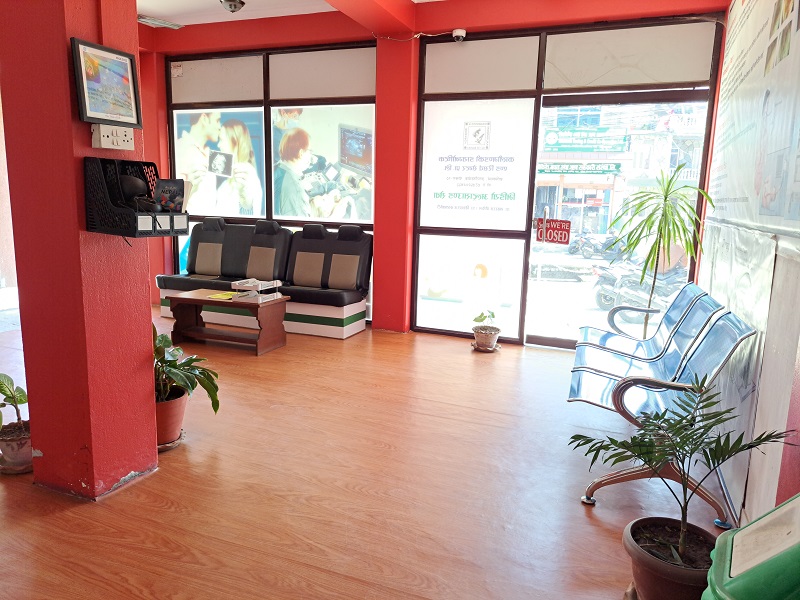
KDRC is on Shantipath at Amarsingh Chowk, Pokhara-10, Kaski. Bring your doctor's request form, ID, your inhalers, a list of your medicines and any earlier PFT reports. Plan to arrive a little early so you can sit and rest before the test; breathing tests are more accurate when you are not out of breath from climbing stairs or rushing.
To book, call 061-553538 or 9856077433, email kaligandaki.dc@gmail.com, or use the appointment form. You can also see all KDRC services or meet our doctors.
How to prepare
- Do not smoke for 24 hours before the test.
- Avoid alcohol for at least 4 hours and a large meal for at least 2 hours.
- Avoid heavy exercise for at least 30 minutes beforehand.
- Wear loose clothing that does not restrict your chest.
- Take or withhold inhalers only as instructed, and bring them with you.
- Bring your request form, ID, medicine list and earlier PFT reports.
- Tell staff about recent surgery, chest infection, heart problems or pregnancy.
How long it takes
Spirometry usually takes about 15 to 30 minutes, and the whole appointment is typically under an hour.
Price in Pokhara
PFT cost depends on which tests are included, such as spirometry alone or with a bronchodilator comparison, so each request is quoted individually. Call 061-553538 or 9856077433 for the current price.
What to expect at KDRC
Arrive at our Shantipath centre a little early, register at reception with your request form, and sit quietly for a few minutes so your breathing settles. A staff member records your age, height and weight, asks about your medicines, recent illnesses and surgery, and checks whether you used an inhaler today. They then demonstrate the breathing manoeuvre. Sitting upright with a soft nose clip, you take the deepest breath you can, seal your lips around a clean mouthpiece and blow out as hard, fast and long as possible while the staff member encourages you to keep going. You rest and repeat this at least three times until the results match. If your doctor requested a bronchodilator comparison, you inhale the medicine and repeat the test after a short wait. Spirometry usually takes 15 to 30 minutes. You may feel briefly lightheaded, so rest before you leave. Our team tells you when to collect your report for your doctor.
Frequently asked questions
Where can I do a PFT test in Pokhara?
You can do a PFT test at Kaligandaki Diagnostic and Research Center (KDRC), Shantipath, Amarsingh Chowk, Pokhara-10. Trained staff coach you through spirometry and other requested breathing measurements. Call 061-553538 or 9856077433 to book and to confirm which tests on your doctor's request form can be done at the centre.
What is the difference between PFT and spirometry?
Spirometry is the most common part of a PFT. It measures how much air you can blow out and how fast. PFT is the wider term for the group of lung tests, which can also include a bronchodilator comparison, lung volumes and diffusion capacity. Your doctor's request form says which ones you need.
How much does a PFT cost in Pokhara?
The cost depends on which tests are included. Spirometry alone differs from spirometry with a bronchodilator comparison or additional measurements. KDRC quotes each request individually and prices are revised from time to time, so call 061-553538 or 9856077433 with your request form details for the current price.
How long does a PFT take?
Spirometry itself usually takes about 15 to 30 minutes, according to Cleveland Clinic, and the NHS says the appointment should take no more than an hour. A bronchodilator comparison adds a short wait and a repeat test. Allow extra time for registration and for resting before the test begins.
Can I eat before a lung function test?
Yes, but avoid a large meal for at least 2 hours before the test, as the NHS advises, because a full stomach makes deep breaths and forceful blows harder. A light snack is fine. Also avoid alcohol for at least 4 hours and smoking for 24 hours beforehand.
Should I stop my inhaler before a PFT?
Only if you are told to. The NHS advises stopping medicines or inhalers only on instruction. Sometimes doctors want results without a reliever inhaler, and sometimes on your usual treatment. Ask your doctor or our staff when you book, never stop a medicine on your own, and bring your inhalers to the test.
Is a PFT painful?
No. A PFT is painless and you only breathe through a mouthpiece. Cleveland Clinic notes that some people feel briefly dizzy, lightheaded or tired, or cough after the forceful blows, and that these effects pass shortly. You can rest between blows, and the staff member will stop if you feel unwell.
Who should not have a PFT?
The NHS says the test may not be safe with a chest infection, certain heart problems, uncontrolled high blood pressure, or after a recent heart attack, stroke or certain surgery. Tell staff about any of these, or about coughing up blood or a recent collapsed lung. The test may be postponed until it is safe.
Can children do a PFT?
Yes, if they can follow instructions. Spirometry needs a full breath in and a fast, complete blow out, so it is usually done in older children, teenagers and adults. Younger children may find it difficult. Your child's doctor will advise whether the test is suitable, and a parent can stay with the child.
Can I have a PFT during pregnancy?
Tell your doctor and our staff before booking if you are pregnant. Spirometry uses no radiation or medicine unless a bronchodilator is requested, but forceful breathing can be tiring. Your doctor will decide whether the test is needed now or can wait, based on your symptoms and the reason for the request.
What does a normal PFT result look like?
Results are compared with predicted values for your age, height and sex. Cleveland Clinic says 80% or more of the predicted value is generally considered normal. The FEV1/FVC ratio helps show whether any reduction is obstructive or restrictive. Your doctor interprets the pattern together with your symptoms and history.
Can a PFT diagnose asthma or COPD?
A PFT is a key part of diagnosing both. WHO states that COPD is confirmed by spirometry, and a bronchodilator comparison helps doctors judge whether narrowing improves, as in asthma. However, the diagnosis is made by your doctor, who combines the test with your symptoms, examination and history.
When will I get my PFT report?
Timing depends on which tests were performed. Our team will tell you when to collect your report at the time of the test. Take the report to the doctor who requested it, and keep copies, because comparing PFT results over time shows whether lung function is stable or changing.
Do I need a referral for a PFT?
A doctor's request is strongly recommended, because it tells staff which tests to perform and whether to use a bronchodilator. It also ensures someone will interpret the results with your history. If you are unsure, call our staff on 061-553538 or 9856077433 and they will guide you.
Can I drive or go to work after a PFT?
Yes, in most cases. A PFT needs no sedation, and any dizziness from the forceful blows usually passes within minutes. Sit and rest until you feel normal before leaving. If you received a bronchodilator, you may feel a slightly fast heartbeat or mild shakiness for a short while.
Sources
- nhs.uk/conditions/spirometry/
- my.clevelandclinic.org/health/diagnostics/17833-spirometry
- my.clevelandclinic.org/departments/respiratory/depts/pulmonary-function-testing
- who.int/news-room/fact-sheets/detail/chronic-obstructive-pulmonary-disease-(copd
- nhs.uk/conditions/chronic-obstructive-pulmonary-disease-copd/
This page is general health information reviewed by our radiologists. It is not a diagnosis — always follow your own doctor's advice. In an emergency, call our 24-hour ambulance or go to the nearest emergency department.
Written by
Dr. Nawaraj PaudelConsultant Radiologist
Consultant Radiologist at KDRC, Pokhara. Residency at East Avenue Medical Centre, Manila; formerly Assistant Professor of Radiology at Universal College of Medical Sciences. Member, Nepal Radiologist Society.
View doctor's profile →
Medically reviewed by
Dr. Bishworaj BastakotiConsultant Radiologist
Consultant Radiologist at KDRC, Pokhara. Residency at the National Kidney and Transplant Institute, Manila; previously at Western Regional Hospital. Member, Nepal Radiologist Society.
View doctor's profile →Shantipath, Amarsingh Chowk, Pokhara-10, Kaski · 061553538 / 9856077433
Related services in Pokhara
192 Slice High Resolution CT Scan
A CT scan in Pokhara at KDRC is a fast, painless X-ray test that uses a computer to create detailed cross-sectional imag…
Bone Mineral Density (BMD)
A BMD test in Pokhara at KDRC is a quick, painless, very low-dose X-ray scan that measures the mineral content of your b…
CT Angiography
CT angiography in Pokhara at KDRC is a contrast-enhanced CT scan that maps the arteries and veins of the heart, brain, n…
EEG
An EEG test in Pokhara at KDRC is a painless recording of the brain's natural electrical activity using small electrodes…